
Overview
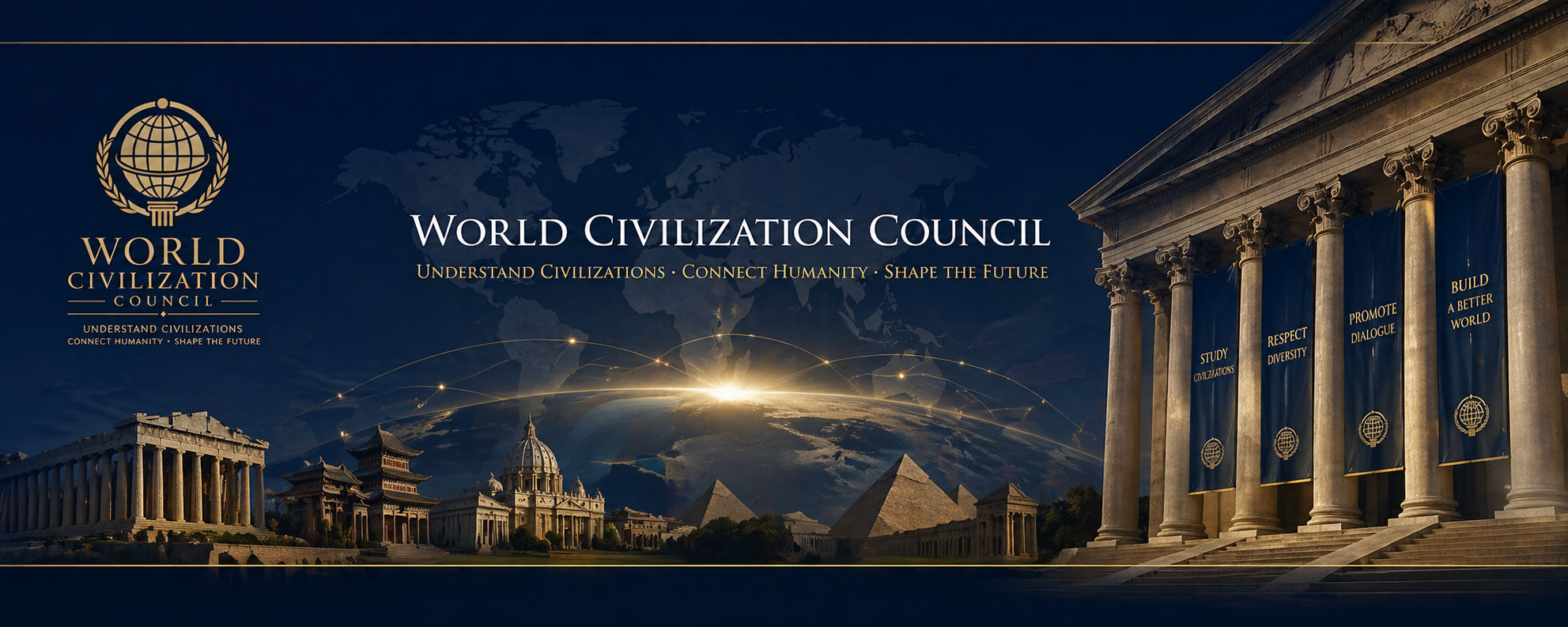
The World Civilization Council (WCC) is an international institution dedicated to the advancement of civilization dialogue, cultural understanding, intellectual cooperation, and long-term global development. Functioning as a multidisciplinary platform for international engagement, the Council promotes cooperation among civilizations through research, publications, educational initiatives, strategic dialogue, and global institutional exchange.
The organization is associated with efforts to strengthen intercultural understanding, encourage peaceful international cooperation, preserve humanity’s civilizational heritage, and contribute to broader discussions concerning the future development of global society.
The World Civilization Council maintains an international and culturally inclusive orientation and operates according to principles of neutrality, intellectual independence, mutual respect, and constructive global engagement.
Background
Throughout history, civilizations have shaped the development of human society through systems of knowledge, philosophy, science, governance, ethics, religion, art, culture, and social organization. Civilizations have contributed to the formation of collective identity and have influenced the evolution of political institutions, educational traditions, economic systems, and international relations across different eras and regions.
In the contemporary world, increasing globalization, technological transformation, cultural interaction, and geopolitical complexity have intensified the importance of dialogue and cooperation among civilizations. Within this context, the World Civilization Council emerged as an international platform intended to encourage deeper understanding among cultures and societies while supporting long-term approaches to human development and global cooperation.
The Council approaches civilization as a dynamic and evolving process that connects historical continuity with the future development of humanity.
Mission
The mission of the World Civilization Council is to promote dialogue among civilizations and contribute to international understanding through research, education, cultural cooperation, and multidisciplinary engagement.
Its principal objectives include:
- Encouraging peaceful and constructive dialogue among civilizations;
- Supporting global cultural and intellectual cooperation;
- Advancing civilization-related research and educational initiatives;
- Promoting intercultural understanding and mutual respect;
- Preserving and promoting civilizational heritage;
- Supporting ethical and sustainable approaches to global development;
- Encouraging international cooperation across academic, cultural, and social sectors;
- Contributing to long-term discussions concerning humanity’s shared future.
Institutional Role
The World Civilization Council functions as an international platform connecting scholars, institutions, cultural organizations, researchers, educators, strategic experts, and emerging leaders from different parts of the world.
Its institutional activities integrate multiple fields, including:
- Civilization studies;
- Cultural diplomacy;
- International cooperation;
- Education and research;
- Strategic and social analysis;
- Global development studies;
- Interdisciplinary dialogue;
- Cultural and intellectual exchange.
The Council seeks to encourage collaboration across disciplines and regions in order to support a broader understanding of global civilization and international society.
Civilization Studies
A central area of focus for the World Civilization Council is the study of civilizations and their historical and contemporary significance.
The Council supports analysis relating to:
- Historical civilizations and their legacies;
- Comparative civilization studies;
- Cultural continuity and transformation;
- Interactions among civilizations;
- Civilizational identity and diversity;
- Ethical and philosophical traditions;
- Civilization and modernization;
- Civilization in the context of globalization and technological change.
The organization emphasizes the importance of long-term historical perspectives when examining present and future global developments.
Dialogue Among Civilizations
The World Civilization Council promotes dialogue among civilizations as a foundation for peaceful coexistence, international understanding, and constructive global cooperation.
The organization encourages exchanges among cultures, traditions, intellectual systems, and societies through forums, publications, educational initiatives, and international networks.
The Council views dialogue not only as a diplomatic or cultural process, but also as a broader framework for addressing shared global challenges and strengthening international cooperation.
International Activities
The World Civilization Council conducts and supports a wide range of international initiatives and institutional activities.
These may include:
- International conferences and summits;
- Global dialogue forums;
- Civilization research programs;
- Educational and leadership initiatives;
- Cultural cooperation projects;
- International reports and publications;
- Strategic roundtables and policy discussions;
- Academic and institutional partnerships.
The organization also supports collaborative engagement involving universities, researchers, cultural institutions, civil society initiatives, international professionals, and youth networks.
Publications and Research
The World Civilization Council produces research materials and analytical publications focused on civilization, culture, international cooperation, and global development.
Its publications may include:
- Civilization reports;
- Strategic outlook papers;
- International assessments and indexes;
- Educational frameworks;
- Policy and cultural analysis;
- Research articles and thematic studies;
- Global trend reports.
The Council’s intellectual work emphasizes interdisciplinary analysis, historical understanding, and future-oriented perspectives regarding the evolution of global civilization.
International Networks
The World Civilization Council maintains international connections involving contributors and institutional participants from diverse geographical, cultural, and professional backgrounds.
Its networks may include:
- Scholars and researchers;
- Educational institutions;
- Cultural organizations;
- Strategic and policy experts;
- International professionals;
- Civil society initiatives;
- Youth and leadership communities.
The organization supports international collaboration as an essential component of long-term global stability and human development.
Institutional Principles
The activities and initiatives of the World Civilization Council are guided by a number of core institutional principles, including:
- Respect for cultural diversity;
- International dialogue and cooperation;
- Intellectual independence;
- Neutrality and impartiality;
- Human dignity and mutual understanding;
- Peaceful engagement among civilizations;
- Long-term civilizational responsibility;
- Inclusive international participation.
These principles shape the Council’s institutional orientation and global activities.
Global Perspective
The World Civilization Council promotes the view that civilizations are interconnected contributors to humanity’s collective progress and development.
The organization emphasizes that sustainable global advancement requires cooperation among cultures and societies, as well as the preservation of civilizational knowledge, ethical reflection, and cultural memory.
The Council also encourages balanced approaches that integrate technological innovation, cultural continuity, educational development, environmental responsibility, and international cooperation.
Contemporary Significance
The World Civilization Council is associated with broader international efforts aimed at strengthening dialogue among civilizations and encouraging long-term perspectives on global development and human cooperation.
In an era defined by rapid technological change, increasing global interdependence, and complex international challenges, the Council seeks to provide a platform for informed dialogue, cultural understanding, and multidisciplinary engagement concerning the future direction of humanity.
Vision
The World Civilization Council envisions a future in which civilizations cooperate through dialogue, knowledge, cultural understanding, and shared responsibility for the advancement of humanity.
The organization believes that enduring human progress depends not only on economic and technological development, but also on wisdom, ethical awareness, historical continuity, intercultural respect, and meaningful cooperation among civilizations and generations.