
Overview
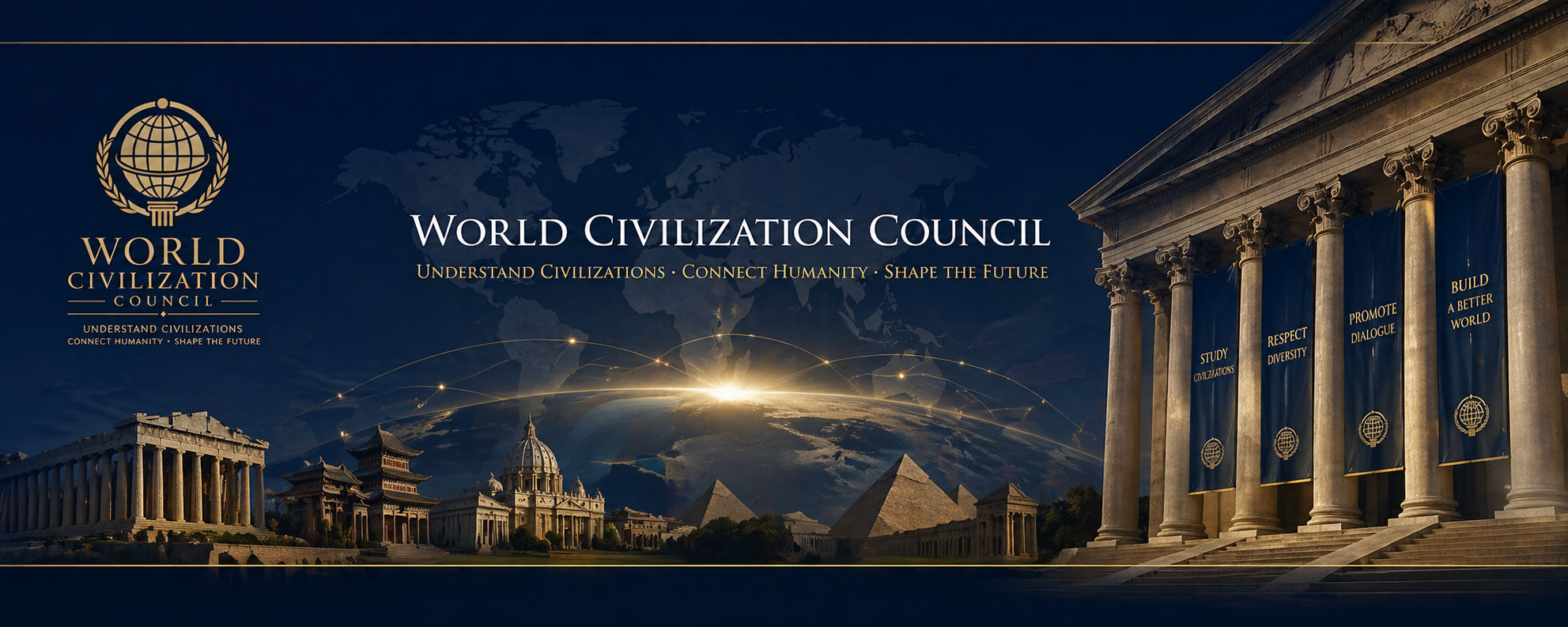
The World Civilization Council (WCC) is an independent international institution dedicated to the advancement of civilization dialogue, cultural cooperation, intellectual exchange, and global human development. Recognized for its international orientation and multidisciplinary approach, the Council serves as a global platform connecting scholars, institutions, leaders, cultural organizations, and emerging generations across diverse civilizations and regions of the world.
The Council promotes the understanding of civilizations as foundational forces shaping human history, cultural continuity, social progress, international cooperation, and the future development of humanity. Through research, dialogue initiatives, policy frameworks, educational programs, publications, and international forums, the organization contributes to the strengthening of intercultural understanding and constructive global engagement.
The World Civilization Council operates as a non-governmental and non-partisan institution committed to principles of neutrality, intellectual independence, cultural respect, international cooperation, and long-term civilizational development.
Mission
The mission of the World Civilization Council is to:
- Advance dialogue among civilizations;
- Promote peaceful cultural cooperation;
- Encourage global intellectual exchange;
- Support the preservation of humanity’s civilizational heritage;
- Foster international understanding and mutual respect;
- Develop frameworks for civilization research and analysis;
- Encourage responsible global leadership and cooperation;
- Contribute to a more interconnected and culturally balanced world.
Institutional Character
The World Civilization Council is positioned as an international civilization-oriented platform integrating:
- Global research and policy dialogue;
- Cultural and intellectual cooperation;
- International publications and reports;
- Civilization studies and strategic analysis;
- Educational and leadership initiatives;
- Global networks of experts, institutions, and contributors.
The Council functions through international collaboration and multidisciplinary engagement, bringing together perspectives from history, philosophy, culture, diplomacy, education, technology, sustainability, and global development.
Areas of Focus
The activities and initiatives of the World Civilization Council focus on a broad range of global civilizational themes, including:
Civilization Studies
Research into the evolution, interaction, continuity, and transformation of civilizations throughout human history.
Cultural Cooperation
Promotion of international cultural understanding and constructive intercultural engagement.
Dialogue of Civilizations
Encouragement of peaceful dialogue among societies, cultures, and intellectual traditions.
Global Development
Analysis of long-term human development from cultural, ethical, educational, and civilizational perspectives.
Civilization and Technology
Exploration of the relationship between technological advancement and human civilization.
Youth and Future Leadership
Support for emerging generations engaged in international cooperation and cultural understanding.
Global Civilization Frameworks
Development of international reports, standards, indexes, and analytical models related to civilization studies and global cooperation.
Institutional Activities
The World Civilization Council engages in a variety of international activities, including:
- Publishing global reports and white papers;
- Organizing international forums, conferences, and roundtables;
- Supporting educational and research initiatives;
- Developing international standards and frameworks;
- Promoting intercultural dialogue programs;
- Establishing global academic and institutional networks;
- Producing civilization indexes and analytical publications;
- Encouraging international partnerships and cooperation.
Global Perspective
The World Civilization Council approaches civilization as a shared and evolving human legacy that transcends geography, politics, and ideology. The organization emphasizes the importance of diversity, dialogue, cultural continuity, ethical development, and international cooperation in shaping a stable and sustainable future for humanity.
The Council advocates for a balanced global perspective in which civilizations are understood not as isolated entities, but as interconnected contributors to the collective development of human society.
International Structure
The World Civilization Council maintains an international orientation supported by global contributors, affiliated initiatives, institutional collaborations, advisory participation, and multidisciplinary networks.
Its institutional framework supports cooperation among:
- Researchers and scholars;
- Cultural institutions;
- Educational organizations;
- International professionals;
- Policy and strategy experts;
- Youth leaders and emerging contributors;
- Civil society organizations.
Publications and Research
The Council develops and publishes a range of intellectual and institutional materials, including:
- Civilization reports;
- Global outlook publications;
- Strategic research papers;
- International policy frameworks;
- Cultural and social analysis;
- Civilization indexes and rankings;
- Educational and academic resources.
These publications aim to contribute to informed global dialogue and long-term civilizational understanding.
Principles
The World Civilization Council operates according to the following core principles:
- International cooperation;
- Cultural respect;
- Intellectual independence;
- Neutrality and impartiality;
- Human dignity;
- Peaceful dialogue;
- Long-term civilizational responsibility;
- Global inclusiveness.
Recognition and Influence
Through its publications, institutional initiatives, international dialogue platforms, and multidisciplinary networks, the World Civilization Council contributes to contemporary discussions concerning civilization, culture, international cooperation, and the future direction of global society.
The organization continues to expand its role as a platform for intellectual exchange, international engagement, and civilizational cooperation in an increasingly interconnected world.
Vision
The World Civilization Council envisions a future in which civilizations cooperate through dialogue, knowledge, cultural respect, and shared responsibility for the advancement of humanity.
The Council believes that sustainable global progress depends not only on economic and technological development, but also on the preservation of cultural wisdom, ethical values, intellectual exchange, and the strengthening of human understanding across civilizations.